

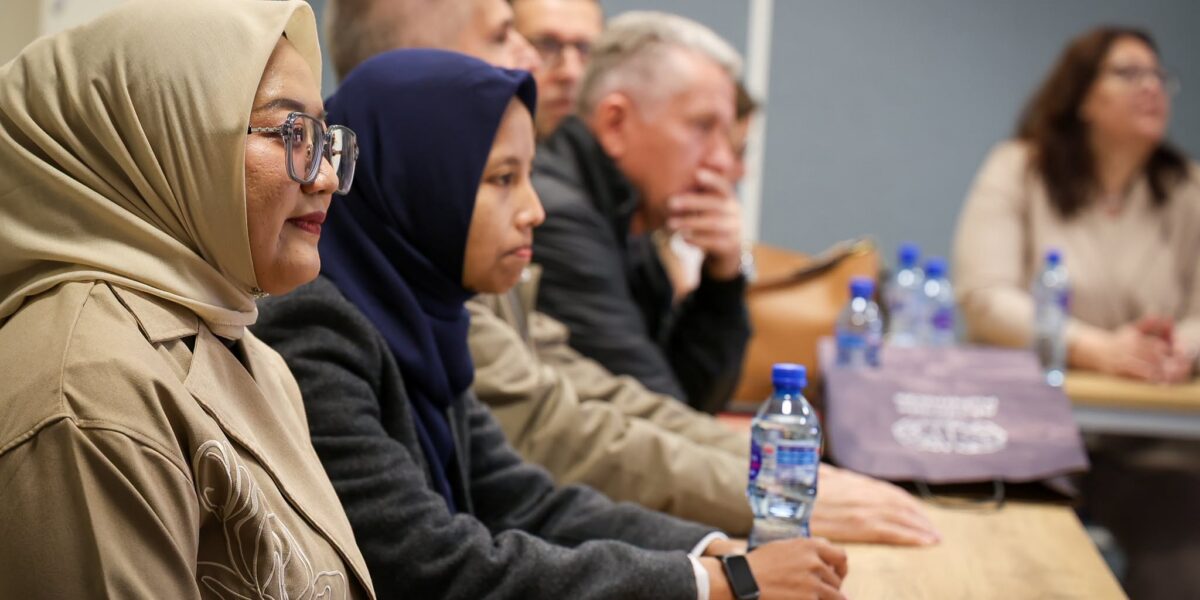
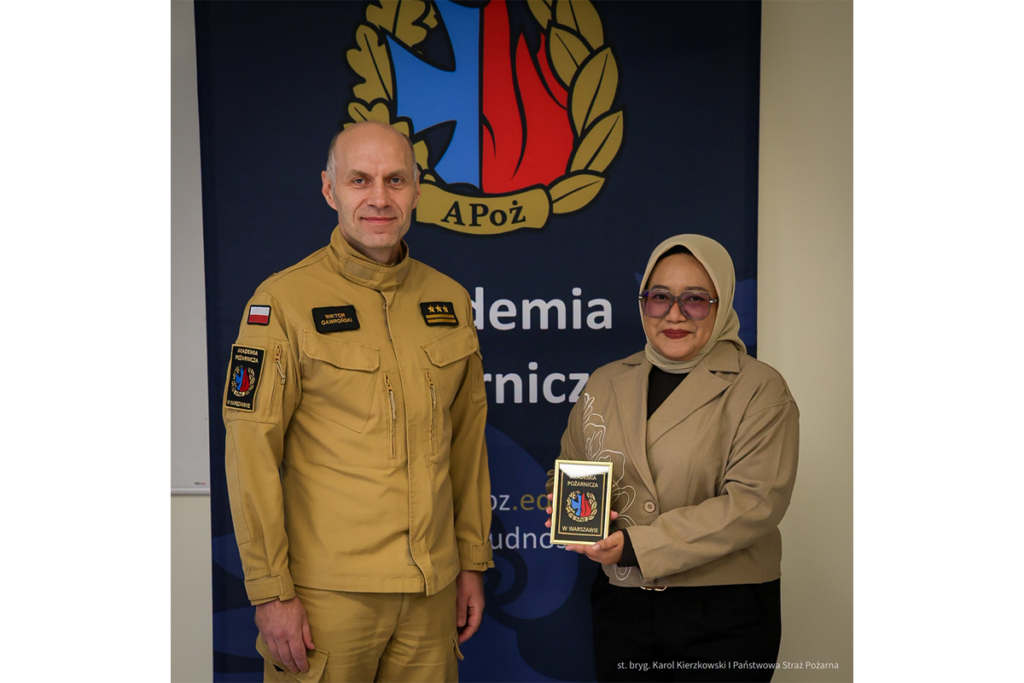
Gardyas Bidari Adninda, S.T., M.A., a lecturer in the Undergraduate Programme in Urban and Regional Planning, Faculty of Science and Technology (FST), Universitas AMIKOM Yogyakarta, participated in Erasmus+ Staff Mobility for Training at Fire University in Warsaw, Poland, on 12–16 October 2026. Through training sessions, laboratory visits, and urban observations, she gained insights into disaster management and the provision of public services and spaces.
Known as Ninda, she joined the programme alongside Eli Pujastuti, M.Kom., from the Undergraduate Programme in Informatics, Faculty of Computer Science, and Aditya Maulana Hasymi, S.IP., M.A., from the Undergraduate Programme in International Relations, Faculty of Economics and Social Sciences. The activity formed part of the cooperation between Universitas AMIKOM Yogyakarta and Fire University under Erasmus+.
During the programme, the delegation attended presentations by academic staff and visited four laboratories to learn about education and research in firefighting and rescue. For Ninda, whose academic interests include disaster management, the experience provided valuable learning relevant to urban and regional planning.
Understanding Disaster Management through a Comprehensive Approach
Ninda views fire management as part of a disaster management cycle encompassing mitigation, preparedness, emergency response, and recovery. Each stage requires preparation to reduce risks and enable an effective response when a disaster occurs.
One aspect that caught her attention was the explanation of fire alarm systems connected to fire services. Fire University also operates its own fire and rescue unit, serving the surrounding area while providing students with practical experience.
This connection between education and public service demonstrated how knowledge is applied to community needs. Students have opportunities to become familiar with equipment and procedures in an operational setting.
The laboratory visits also highlighted the breadth of knowledge required by emergency personnel. Participants were introduced to the testing of combustible materials, emergency medical care, and research into protective equipment.
Ninda highlighted the testing of firefighting clothing and helmets to assess their ability to protect against heat. In her view, protecting emergency personnel is an essential component of a comprehensive rescue system.
“I could see that they considered the whole picture, from firefighters’ safety and knowledge to the medical personnel,” Ninda said.
Using the City as a Learning Environment for Urban Planning
Ninda’s learning continued as she observed urban life in Warsaw. As an urban and regional planning lecturer, she regards visits to different cities as opportunities to examine how spaces and services are planned to meet community needs.
“I always tell students studying urban and regional planning to explore different places frequently, because they are observing a living laboratory,” she explained.
According to Ninda, every city has distinctive characteristics that offer opportunities for observation. First-hand experience helps students understand the relationship between planning and people’s everyday activities.
In Warsaw, she was particularly interested in public transport connectivity. She described travelling between destinations by tram, metro, and bus, with connections that supported transfers between modes.
The delegation also used 24-hour tickets for multiple journeys across the available transport modes. This experience illustrated the importance of integrating routes, interchanges, and ticketing to support urban mobility.
Beyond transport, Ninda observed the availability of parks and public open spaces. These places allow people to meet, converse, and engage in activities without having to use commercial venues.
For urban and regional planning education, these observations offered a basis for reflection on public access to shared spaces. Urban planning addresses residents’ needs to move around, interact, and comfortably carry out their daily activities.
Expanding International Learning Opportunities for FST Students
Further cooperation with Fire University also includes student mobility. Ninda stated that two students are scheduled to undertake one semester of study in the spring semester of 2027: Seno from Informatics and Amar from Architecture, FST.
She hopes the opportunity will provide academic experience while strengthening their independence. Preparing documents, travelling, settling into accommodation, and navigating language differences will all form part of their learning experience.
“The hope is that they will become more resilient—as students and as individuals—through the experience,” Ninda said.
Ninda also sees opportunities to extend cooperation through disaster-related research, academic staff mobility, and the joint development of modules or courses. Meetings with participants from Kosovo and Bulgaria provided opportunities to identify potential areas for future collaboration.
Through her experience at Fire University and observations of Warsaw, Ninda gained perspectives connecting safety, mobility, and communities’ spatial needs. These insights can enrich teaching within FST, particularly by helping students understand urban and regional planning through real-world conditions.
Fadya RY – Directorate of Public Relations and International Affairs
Correspondent: Gardyas Bidari Adninda